I have been thinking about the future of illustration lately with the advent of AI. Are we led to believe that illustration is one of the first crafts to go? The best analysis of this question so far I’ve found in The AI Con:
We’re writing about the seemingly disparate fields of art, science, and journalism in the same chapter because creativity is at the heart of all of these fields. These fields are often the targets for those seeking to prove the ‘intelligence’ of their AI systems. But synthetic artifacts that look like the products of these fields aren’t evidence of creativity of the machines. To the extent that there is any value at all, it is due to the creativity of the human workers who produced the original art, science, or journalism that was appropriated as training data.
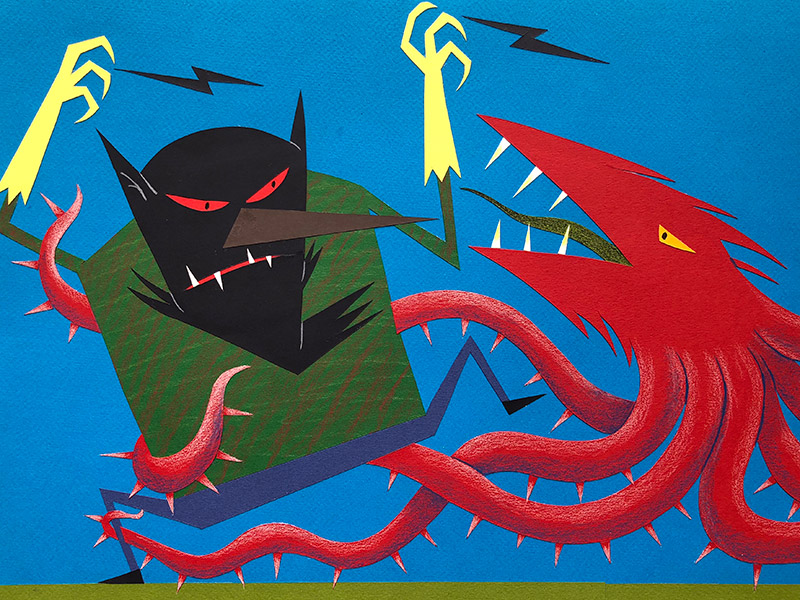
A framing that I would go for is that illustration is about making the invisible visible in a particular context to convey meaning. It reveals something that is otherwise hidden from us. Now AI can probably also do this in a serendipitous way, but how would AI decide what to make visible? Well, we would create restraints, guardrails, skills etc., to guide the output that we want. In wanting to tell a particular story with an image I have not had great results with AI.
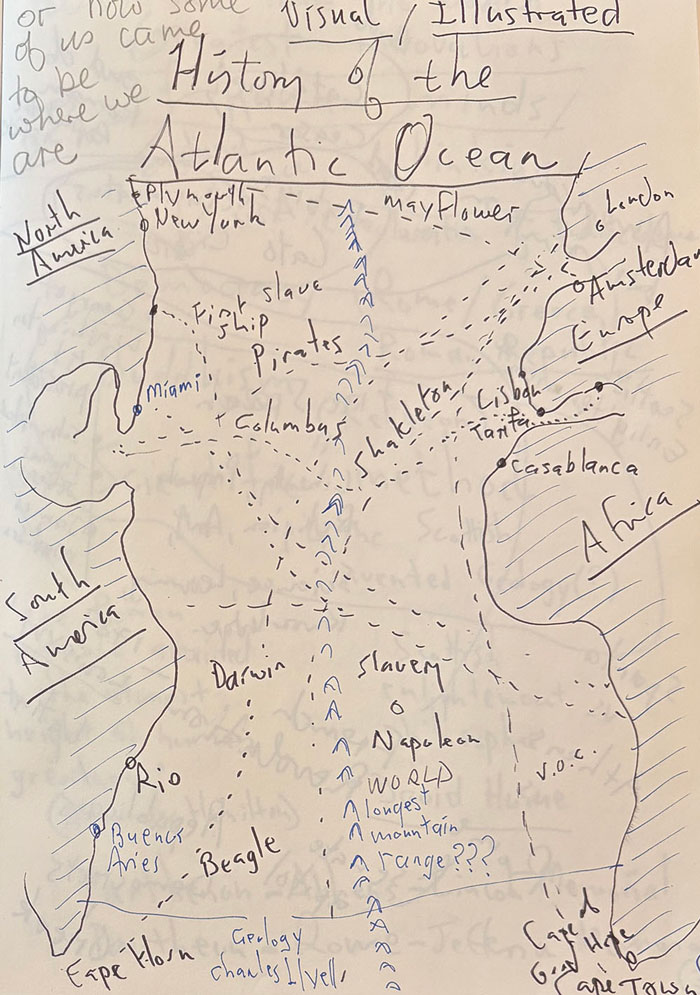
In line with this train of thought, my next experiment is taking shape. I love maps. I love history. How can I bring a subject to life by drawing the connections between things as opposed to focusing on the things themselves. My travels to cities that line the Atlantic has made me think about the history of the Atlantic – how people came to be where they are and the events behind it, how oceans are canvasses on which the trails of history unfolded. I’m exploring how to make an illustrated book following this principle. I’m not sure how to yet, but I’m sure to ask AI to help…